


Publishing service pricing varies because of multiple cost components that differ by provider, including printing expenses, distribution fees, commission rates, and file revision charges. Why publishing service pricing varies is not a mystery once you understand the underlying economics. Platforms like Amazon KDP, IngramSpark, and Books.by each operate on different business models, and those structural differences produce real price gaps that directly affect your royalties. A lower upfront cost does not guarantee higher earnings per sale. Understanding the full cost equation, from print cost to platform commission to distribution fee, is the only way to make a decision that actually serves your publishing goals.
Why publishing service pricing varies across platforms
Print cost is the single largest variable in publishing service costs, and it follows a straightforward formula: a base charge plus a per-page rate. A 300-page paperback on one platform might cost $3.65 to print while the same book costs $4.20 on another. That $0.55 difference per copy compounds fast across hundreds of sales.
The total royalty calculation works like this: list price minus printing cost minus platform commission equals author earnings. Change any one of those three variables and your take-home shifts. This is why comparing platforms on print cost alone gives you an incomplete picture.

Supply chain pressures make this even more unpredictable. Print cost volatility is driven by paper mill consolidation, rising energy costs, and higher transportation expenses. Fewer mills in operation means less competitive pricing on raw materials, and those costs flow directly to print-on-demand providers and then to authors.
| Provider | Estimated print cost (300-page paperback) | Commission model |
|---|---|---|
| Amazon KDP | Lower per-unit cost | 40% commission on list price |
| IngramSpark | Mid-range per-unit cost | Wholesale discount model |
| Books.by | Higher per-unit cost | 0% commission |
| Lulu | Mid-range per-unit cost | Percentage-based royalty |
Print quality across these platforms is generally comparable. Books.by and Lulu share a print network that produces high-quality output. KDP Print and IngramSpark deliver similarly strong results with minor finish variations. This means price differences between providers are almost never about quality. They reflect business model choices, not production standards.
Platform fee increases often reflect operational risk management rather than pure profit motives. When paper prices spike or logistics costs rise unpredictably, providers build that uncertainty into their pricing structures. Authors absorb that volatility whether they realize it or not.
Pro Tip: Never evaluate a platform solely on its print cost per unit. Run the full math: list price minus print cost minus commission. A platform with a higher print cost but zero commission can yield more per sale than a cheaper-to-print competitor taking 40%.
How do distribution fees and royalties affect what you actually earn?
Distribution fees and commission structures are where publishing service pricing explained gets genuinely complicated. Three distinct models exist: fixed upfront fees, percentage-based royalties, and wholesale discount arrangements. Each one changes the timing and size of your earnings.
Amazon KDP uses a tiered royalty structure. Books priced between $2.99 and $9.99 qualify for a 70% royalty on eBooks, while books outside that range earn 35%. For print, KDP takes roughly 40% of the list price as its commission, then subtracts the print cost from the remainder. The platform subsidizes its low print costs through marketplace volume and commission revenue.
IngramSpark operates on a wholesale discount model. You set a wholesale discount, typically 40% to 55%, which determines what retailers pay. IngramSpark then takes its cut from that discount before passing earnings to you. The 2026 fee increase to 1.875% market access adds another layer of cost that many authors did not budget for when they originally set their pricing.
Books.by takes a different approach entirely. Its subscription model charges 0% commission on sales. The higher print cost but greater net royalty dynamic at Books.by demonstrates exactly why the total math matters more than any single line item. An author selling a $16.99 paperback through Books.by can net more per copy than through a platform with lower print costs but a 40% commission.
Distribution coverage also affects pricing. Platforms with access to bookstores, libraries, and international retailers charge more because they deliver more. IngramSpark’s wholesale network reaches over 40,000 retailers globally. That reach costs money, and that cost appears somewhere in the fee structure.
Pro Tip: Calculate your “net per sale” for every platform before uploading your book. Take your list price, subtract the print cost, then subtract the platform’s commission or wholesale discount. That final number is what you actually earn. Compare that number across platforms, not the headline royalty percentage.
How do revision fees cause publishing costs to fluctuate over time?
Revision fees are the most underestimated factor in why publishing fees fluctuate, especially for authors who update their books regularly. Most platforms offer a free revision window after your initial upload. Once that window closes, charges apply per file change.
IngramSpark charges $25 per file revision after 60 days. That applies separately to your interior file and your cover file. A single update to fix a typo and refresh the cover costs $50. For an author with a catalog of ten titles making periodic updates, those charges add up to hundreds of dollars annually.
Here is what that means practically for your publishing cost planning:
- Proof before you publish. Hire a proofreader and a cover designer who delivers print-ready files. One round of professional editing costs less than repeated revision fees over two years.
- Batch your updates. If you know a second edition is coming, hold all changes until you are ready to upload everything at once rather than making incremental fixes.
- Understand the free window. Most platforms give you 30 to 60 days after upload to make free corrections. Use that window aggressively to catch errors before the clock runs out.
- Factor revision costs into your catalog budget. If you manage more than five titles, revision fees become a predictable annual expense that belongs in your financial planning.
- Compare policies before committing. KDP allows free interior and cover updates at any time, which is a meaningful cost advantage for authors who revise frequently.
Upfront cheap publishing offers often carry hidden revision charges that increase total costs unexpectedly. A platform that charges nothing to upload can still cost you significantly more over a three-year period than one with a modest upfront fee but no revision charges.
Comparing provider business models and what they mean for your costs
The reason publishing service costs differ so dramatically comes down to four distinct business model types. Each one allocates costs differently between the author and the platform.
Marketplace commission model (Amazon KDP): KDP subsidizes its print costs through the volume of its marketplace. Authors pay no upfront fee and get low print costs, but surrender 40% of each print sale. This model favors authors who sell primarily on Amazon and want minimal setup costs.
Wholesale distribution model (IngramSpark): IngramSpark charges a setup fee for some titles, applies a market access fee, and operates on wholesale discounts. The advantage is broad retail distribution. The cost is a more complex fee structure with revision charges and the 2026 fee increase that affects ongoing expenses.
Subscription model (Books.by): Books.by charges a monthly or annual subscription and takes 0% commission. Print costs are higher per unit, but authors keep the full margin above print cost. This model rewards authors with consistent sales volume where the subscription fee becomes negligible per unit.
Package pricing model (BookBaby): BookBaby charges upfront package fees covering distribution, ISBN, and setup. There are no ongoing commissions on most plans. This suits authors who want a one-time cost and predictable economics, though the upfront investment is higher than other models.
Successful indie authors commonly run a diversified platform strategy. They use KDP for Amazon sales where its marketplace reach is unmatched, IngramSpark for bookstore and library distribution, and a zero-commission platform for direct sales. This approach captures the strengths of each model while managing the weaknesses. The indie publishing cost structures behind each platform reward authors who take time to understand them rather than defaulting to the most familiar name.
Key takeaways
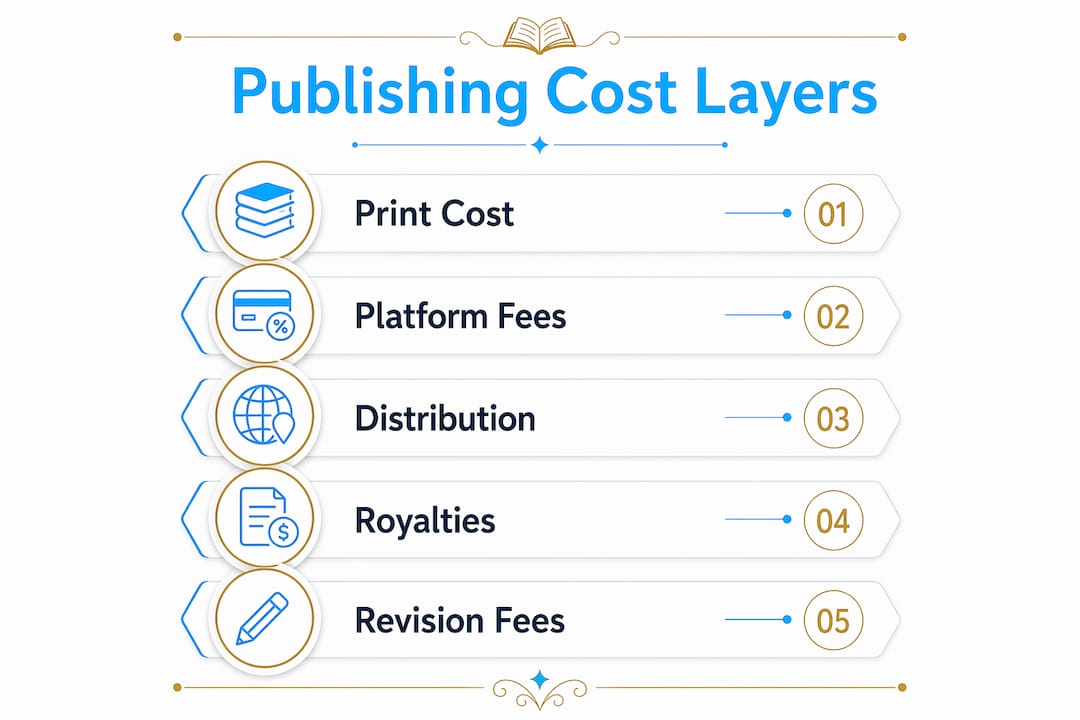
Publishing service pricing varies because of four compounding cost layers: print cost, platform commission, distribution fees, and revision charges. No single number tells the full story.
| Point | Details |
|---|---|
| Print cost is just the starting point | Always calculate list price minus print cost minus commission to find your true earnings per sale. |
| Commission models change everything | A 0% commission platform with higher print costs can yield more per sale than a low-print-cost platform taking 40%. |
| Revision fees compound over time | IngramSpark charges $25 per file after 60 days, making proofing discipline a direct cost-saving strategy. |
| Business models drive price variation | KDP, IngramSpark, Books.by, and BookBaby each allocate costs differently, favoring different author goals. |
| Multi-platform strategies optimize earnings | Combining platforms by strength, such as KDP for Amazon reach and Books.by for direct sales, maximizes net royalties. |
What I have learned from watching authors get blindsided by publishing costs
Most authors I have worked with focus on the wrong number first. They see a low print cost or a zero-setup-fee offer and assume they have found the best deal. The actual cost conversation does not happen until they run their first royalty report and realize their $14.99 paperback is netting them $1.83 per copy.
The revision fee problem is the one that frustrates me most. An author spends months writing a book, uploads it, and then notices a formatting error three months later. That $25 fix feels punitive when you are already operating on thin margins. The solution is not to avoid platforms with revision fees. The solution is to build a pre-upload checklist that catches every issue before the free window closes.
I also think the multi-platform conversation is underrated. Most publishing advice treats platform selection as a binary choice. In practice, the authors I see doing well treat their distribution like a portfolio. They put their Amazon sales through KDP, route bookstore orders through IngramSpark, and use a direct sales channel with better margins for their website and events. That structure takes more setup time, but the publishing service cost comparison math usually justifies it within the first year.
One more thing: print quality anxiety is mostly unfounded. Authors sometimes pay premium prices assuming they are buying better print quality. The data does not support that. Major print-on-demand networks produce comparable output. You are paying for distribution reach, commission structure, and service features, not better paper or ink.
The authors who navigate this well are the ones who treat publishing like a business from day one. They read the fee schedules, run the royalty math, and make decisions based on net earnings rather than headline numbers.
— James
How Altopublishinggroup helps you decode publishing costs

Altopublishinggroup works with independent authors who are tired of guessing what publishing actually costs. The team provides transparent publishing cost comparisons that break down print fees, commissions, and distribution charges side by side so you can see exactly what you will earn before you commit to a platform. Beyond cost analysis, Altopublishinggroup supports authors with professional editing and publishing services, author branding, and marketing assets that make your book market-ready without surrendering your royalties or creative control. If you want to publish with confidence and keep more of what you earn, Altopublishinggroup is built for exactly that.
FAQ
Why do publishing service costs differ so much between platforms?
Publishing service costs differ because each platform uses a different business model, combining print costs, commission rates, and distribution fees in unique ways. The total author earnings depend on all three variables together, not any single charge.
How much do publishing services cost for a self-published book?
Publishing service costs range from zero upfront on platforms like Amazon KDP to several hundred dollars for package-based services like BookBaby. The more relevant number is your net earnings per sale after print cost and commission are deducted.
What causes publishing fees to fluctuate year to year?
Publishing fees fluctuate due to supply chain pressures including paper price increases, energy costs, and logistics expenses, as well as platform-level policy changes. IngramSpark’s 2026 market access fee increase to 1.875% is a direct example of how operational costs translate into author fee changes.
Are revision fees a significant part of publishing pricing?
Revision fees become significant for authors who update their books after the free revision window closes. IngramSpark charges $25 per file after 60 days, meaning a cover and interior update together costs $50 per title per revision round.
Is it worth using multiple publishing platforms to manage costs?
Using multiple platforms is a proven strategy among successful indie authors. Combining KDP for Amazon marketplace access, IngramSpark for retail distribution, and a zero-commission platform for direct sales captures the cost and reach advantages of each model simultaneously.
Recommended
- Compare Book Publishing Service Costs: 2026 Guide
- Alto Publishing Group | A Publishing Company For Authors – Alto Publishing Group
- Book Publishing & Editing Services | Professional Author Publishing | Alto Publishing Group
- Author Website Design & SEO Services | Alto Publishing Group – Alto Publishing Group


