


Publishing costs authors money because every stage of bringing a book to market carries direct expenses, from professional editing and cover design to marketing campaigns and ongoing business overhead, regardless of which publishing path you choose. The financial burden on authors is real whether you sign with a traditional house, self-publish through Amazon KDP, or work with a hybrid publisher. Understanding the full scope of these costs before you start is the difference between a sustainable author career and a project that drains your savings. This guide breaks down every major expense category, compares how the three publishing models shift financial risk, and shows you how to budget and plan with clear eyes.
Why publishing costs authors money across every publishing path
Publishing costs authors money because producing, distributing, and marketing a book requires professional labor, technology, and time. None of those inputs are free, and the publishing model you choose determines who pays upfront versus who pays later through reduced royalties.
The expenses for authors fall into three broad categories: production, visibility, and business operations. Separating these two cost types is the first step toward understanding your true financial exposure as an author.
Production costs cover everything needed to turn a manuscript into a publishable book. Professional editing across developmental, line, copy, and proofreading stages for a 50,000-word manuscript can cost between $5,000 and $13,750. That figure alone surprises most first-time authors. Cover design from a professional designer runs $300 to $1,500 for print and ebook formats. Interior formatting adds another $100 to $500 depending on complexity.
Visibility costs include everything that gets your book in front of readers: launch campaigns, Amazon ads, social media promotion, book review services, and ongoing marketing. These costs do not stop at launch. Active self-published authors spend $5,000 to $15,000 or more annually on promotions, email marketing tools, and advertising alone.

Business operation costs are the hidden publishing fees most authors forget entirely. Website hosting runs $120 to $300 per year. Email marketing platforms like Mailchimp or ConvertKit cost $240 to $2,400 annually depending on your list size. Accounting software or a bookkeeper adds $200 to $1,000 per year. These recurring author business expenses accumulate quietly in the background while you focus on writing.
Pro Tip: Build a publishing budget spreadsheet with three columns: production, visibility, and business operations. Assign a realistic dollar range to each line item before you spend a single dollar. Authors who skip this step routinely underestimate total costs by 40% or more.
How traditional, self-publishing, and hybrid models compare financially
The three publishing models do not eliminate costs. They redistribute who pays, when, and how much control you keep in exchange.
| Publishing model | Who pays upfront | Royalty rate | Cash flow timing |
|---|---|---|---|
| Traditional | Publisher covers production | 10–15% print, ~25% net ebook | Delayed until advance earns out |
| Self-publishing | Author pays all production costs | Up to 70% ebook royalties | Immediate per sale after costs recoup |
| Hybrid | Author pays partial fees | 50–70% depending on contract | Faster than traditional, slower than pure self-pub |
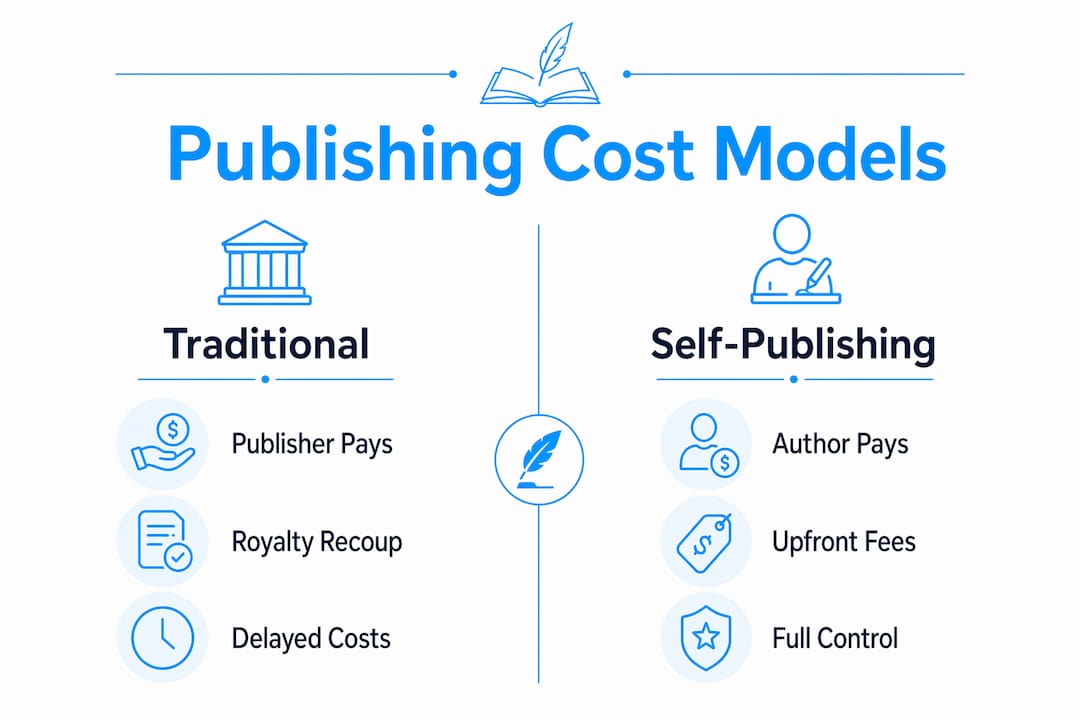
Traditional publishing looks free on the surface because the publisher funds editing, design, and distribution. The real cost is structural. Advances are loans against future royalties, not gifts. A $10,000 advance at a 10% print royalty requires selling roughly 6,700 copies before you see a single additional dollar. Royalty statements read zero until every recoupable dollar is covered. For most authors, that earning-out phase takes years.
Self-publishing flips the model. You pay $5,000 to $20,000 upfront across scattered production and marketing costs, but you keep up to 70% royalties on ebooks sold through Amazon KDP. To put that in concrete terms: a $4.99 ebook earns a self-published author roughly $3.49 per sale versus about $0.87 from a traditional deal. The royalty gap is significant, but you carry all the financial risk upfront.
Hybrid publishing sits between those two poles. You pay reduced production fees and receive professional support, while keeping a higher royalty share than traditional publishers offer. The tradeoff is that you still need capital to start, and the quality of hybrid publishers varies widely. Reviewing a detailed publishing service cost comparison before committing to any hybrid deal is worth the time.
Pro Tip: Before signing with any publisher, calculate your break-even point. Divide your total upfront costs by your expected royalty per unit. That number tells you exactly how many copies you need to sell before the project pays for itself.
Why authors underestimate publishing costs and how to budget realistically
Authors underestimate the costs of publishing a book for one consistent reason: the expenses are scattered across multiple categories and time periods, so no single invoice ever shows the full picture.
Here is a practical framework for building a realistic publishing budget:
- List every production cost before you start. Get quotes from at least two editors and two cover designers. Add formatting, ISBN registration ($125 for a block of 10 through Bowker), and any copyright registration fees. Do not estimate. Get real numbers.
- Project 12 months of visibility costs. A realistic book launch budget includes an advance review copy campaign, a launch week promotion, and at least three months of paid advertising. Budget $1,500 to $5,000 minimum for a serious launch, separate from ongoing monthly ad spend.
- Include annual business overhead. Add your website hosting, email platform, accounting software, and any professional memberships. These recurring business expenses are easy to overlook because they feel like general life costs, but they are publishing expenses.
- Account for your time. If you spend 200 hours managing your own marketing instead of writing, and your writing time is worth $50 per hour, that is $10,000 in opportunity cost. Outsourcing tasks that drain your time often costs less than the income you sacrifice by not writing.
- Add a 20% contingency buffer. Unexpected costs appear in every publishing project. A second round of editing, a cover redesign, a delayed launch, or a platform fee change can each add hundreds of dollars. Build the buffer in before you need it.
Comparing self-publishing support options early in your planning process helps you identify which services to hire out and which to handle yourself, which directly affects your total budget.
How tax deductions reduce the net cost of publishing
Self-publishing authors operate as self-employed business owners, and that classification comes with a meaningful financial advantage. You can reduce your net publishing costs by deducting legitimate business expenses on IRS Schedule C.
Deductible publishing expenses include:
- Editing and proofreading fees paid to freelancers
- Cover design and interior formatting costs
- Website hosting and domain registration
- Email marketing platform subscriptions
- Advertising and promotional spend on platforms like Amazon Ads or BookBub
- Accounting software such as QuickBooks or FreshBooks
- Home office deduction if you write from a dedicated workspace
- Professional development including writing courses, conferences, and industry memberships
The self-employment tax rate adds 15.3% on top of your regular income tax, which surprises many first-time author-entrepreneurs. Understanding how freelance tax obligations work before your first profitable year prevents a painful surprise at tax time.
Recordkeeping is the foundation of every deduction. Save every receipt, invoice, and bank statement related to your publishing business. Accounting tools like Wave (free) or QuickBooks Self-Employed make this manageable without hiring a full-time bookkeeper. The tax savings on $10,000 in deductible expenses can realistically reduce your tax bill by $2,500 to $4,000 depending on your bracket, which meaningfully changes the true impact of publishing costs.
Key takeaways
Publishing costs authors money through production, visibility, and business expenses that accumulate across every publishing model, making detailed budgeting and tax planning non-negotiable for any serious author.
| Point | Details |
|---|---|
| All models carry costs | Traditional delays costs through royalty recoupment; self-publishing requires upfront payment. |
| Production costs are significant | Editing a 50,000-word manuscript alone can cost between $5,000 and $13,750. |
| Ongoing expenses add up fast | Annual business overhead including hosting, email tools, and accounting can reach $15,000. |
| Tax deductions reduce net costs | IRS Schedule C deductions on editing, marketing, and software lower your real out-of-pocket total. |
| Budget with a 20% buffer | Unexpected costs appear in every project; build contingency into your plan before you spend. |
The financial reality most publishing advice skips
I have worked with enough authors to know that the most damaging financial mistake is not overspending on editing or design. It is treating publishing as a creative project instead of a business from day one.
The authors who struggle financially are almost always the ones who made decisions based on enthusiasm rather than numbers. They hired the first editor they found, skipped a proper launch budget because “the book will sell itself,” and then discovered six months later that they had spent $12,000 with no clear path to recouping it. That is not a publishing problem. That is a planning problem.
What I have found actually works is building your budget before you write the final chapter. By the time your manuscript is done, you should already have quotes from editors, a shortlist of cover designers, and a rough 12-month marketing plan with dollar amounts attached. That discipline changes everything. It forces you to treat your book as a product with a market, not just a passion project.
The other thing most articles will not tell you: the learning curve itself is expensive. Every hour you spend figuring out Amazon KDP metadata, BookBub promotions, or email automation is an hour you are not writing your next book. For many authors, the smartest financial decision is investing in professional support early rather than spending months learning systems that a specialist can handle in days. The time cost is real, and it compounds.
Publishing is a long game. Royalty income builds slowly, and the authors who stay in it are the ones who planned for that reality from the start. See your publishing investment the way a small business owner sees startup costs: necessary, manageable with planning, and recoverable with consistent effort.
— James
How Altopublishinggroup helps authors control publishing costs

Altopublishinggroup was built specifically for authors who want professional results without the financial chaos that comes from piecing together services from a dozen different vendors. From editing coordination and cover design to author websites, book marketing assets, and media features, every service is designed to reduce the time and money you spend managing your own publishing project.
Rather than hiring separately for every production and visibility need, authors who work with Altopublishinggroup get bundled support that keeps costs predictable and quality consistent. Explore the publishing and editing services available, or start with a detailed look at the 2026 service cost breakdown to see exactly what professional publishing support costs and what it delivers. You keep your royalties and your creative control. Altopublishinggroup handles the rest.
FAQ
Why does publishing cost money even with a traditional deal?
Traditional publishers cover production costs upfront but recoup them through your royalties. You effectively pay through delayed income, since royalty statements read zero until the advance earns out, which can take years.
How much do authors typically pay to self-publish a book?
Authors typically spend between $5,000 and $20,000 on a self-published book when accounting for editing, cover design, formatting, and a launch marketing campaign. Ongoing annual business expenses can add another $5,000 to $15,000.
What are the most commonly overlooked publishing expenses?
Email marketing platform subscriptions, website hosting, accounting software, and paid advertising are the hidden publishing fees most authors forget to budget for. These recurring costs accumulate to thousands of dollars annually.
Can authors deduct publishing costs on their taxes?
Yes. Self-publishing authors file IRS Schedule C and can deduct editing fees, cover design, website hosting, marketing spend, and software subscriptions as legitimate business expenses, which reduces their net publishing costs.
Is self-publishing or traditional publishing cheaper overall?
Neither is cheaper in absolute terms. Traditional publishing delays costs through royalty recoupment while self-publishing requires upfront investment. Self-published authors earn significantly higher royalty rates per sale, which can make the upfront cost worthwhile at sufficient sales volume.


