


Author publishing independence is defined as an author’s full ownership and control over their book’s publishing rights, allowing them to manage creative decisions and revenue without transferring ownership to a third party. This concept sits at the heart of every choice you make as a writer, from signing a contract to choosing a distributor. The industry term most closely aligned with this concept is rights retention, and understanding it separates authors who build lasting careers from those who unknowingly sign away their futures. Whether you are exploring self-publishing for authors, hybrid models, or assisted publishing, the question of who owns your rights determines everything.
What is author publishing independence, exactly?
Author publishing independence means you, the author, hold the copyright and control how your book is published, distributed, priced, and licensed. Rights retention is the bedrock of autonomy, and losing even partial rights jeopardizes your creative and financial future. The moment you sign a contract that transfers rights broadly, you lose the ability to make decisions about your own work without someone else’s approval.
The term “independent author” covers a wide range of arrangements. Some authors self-publish entirely on their own through platforms like Amazon KDP or IngramSpark. Others work with hybrid publishers or assisted publishing services that provide professional support without claiming ownership. What unites all genuinely independent authors is one fact: they retain their rights. The label “indie” alone does not guarantee independence. You must verify what rights you actually hold.

Self-published authors automatically own all rights unless they explicitly license them out. This is the default legal position under U.S. copyright law. The practical implication is significant. You can publish your book on multiple platforms simultaneously, license the audio rights to a separate producer, sell translation rights to a foreign publisher, and keep 100% of the revenue from each deal. That flexibility is the real financial power of publishing independence.
What does it mean to retain publishing rights?
Retaining publishing rights means you keep legal ownership of your copyright and only grant others limited, specific permissions to use your work. The critical distinction here is ownership versus licensing. Ownership never changes hands when you self-publish. Licensing is a temporary, defined permission you grant to a distributor, retailer, or service provider to perform a specific function.
Publishing rights break down into several categories that you need to understand before signing anything:
- Print rights: The right to produce and sell physical copies of your book
- Digital rights: The right to distribute ebook formats through platforms like Amazon KDP, Apple Books, or Kobo
- Audio rights: The right to produce and sell audiobook versions, a fast-growing revenue stream
- Translation rights: The right to publish your book in other languages and territories
- Film and adaptation rights: The right to adapt your work for screen, stage, or other media
- Territory rights: Geographic scope of any license, whether domestic, regional, or worldwide
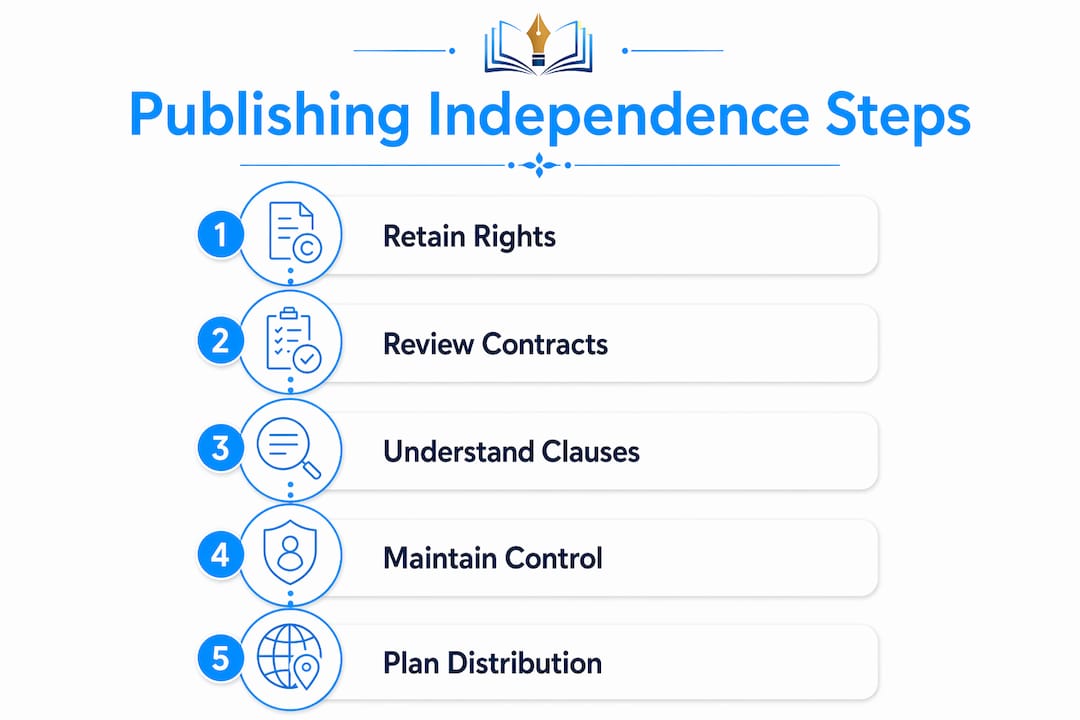
Key contract clauses including Grant of Rights, Copyright, Royalties, and Out of Print determine rights ownership and earnings distribution. Each clause shapes what you keep and what you give away. A contract that grants “all rights, all formats, worldwide, in perpetuity” is the worst outcome for an independent author. It hands over every category listed above with no expiration date.
Pro Tip: When reviewing any publishing contract, locate the Grant of Rights clause first. If it uses phrases like “all rights,” “worldwide,” or “in perpetuity” without specific carve-outs, treat it as a red flag and consult a publishing attorney or the Authors Guild before signing.
How do contracts influence author independence?
Contracts are the single most powerful tool in either protecting or destroying your publishing independence. Most authors focus on royalty percentages, but the clauses that define rights, exclusivity, and reversion have far greater long-term consequences. Understanding clauses like grant of rights, reversion, exclusivity, and royalties is vital for authors to safeguard independence.
The four contract clauses that matter most to your independence are:
Grant of Rights defines exactly which rights you are licensing. A narrow grant, such as “exclusive print rights in North America for five years,” protects you. A broad grant, such as “all rights in all formats worldwide,” strips you of control across every format and territory.
Exclusivity determines whether you can publish the same work elsewhere during the contract term. Exclusive agreements lock you into one publisher or platform. Non-exclusive agreements let you distribute through multiple channels simultaneously, which is standard practice in independent publishing.
Reversion clauses specify the conditions under which your rights return to you if the publisher fails to perform. Without a clear reversion clause tied to specific sales thresholds or timelines, your rights can remain trapped with a publisher indefinitely, even if they stop actively selling your book.
Royalty structures determine your share of revenue. Traditional publishers typically offer 10 to 15 percent of net sales for print. Independent and hybrid models routinely return 60 to 70 percent or more to the author.
| Scenario | Rights retained | Royalty share | Creative control |
|---|---|---|---|
| Traditional publishing deal | Publisher holds most rights | 10–15% of net sales | Limited; publisher controls cover, pricing |
| Broad hybrid agreement | Shared or publisher-held | Varies; often reduced | Partial; approval clauses may apply |
| Rights-retaining hybrid model | Author retains all rights | Author keeps 100% | Full; publisher provides services only |
| Full self-publishing | Author retains all rights | Author keeps 60–70%+ | Full; author controls all decisions |
Creative control may be compromised if a publisher controls cover design or marketing through broad or vague approval clauses. Independence requires narrow, specific grants that separate the services being purchased from any transfer of rights.
Pro Tip: Ask any publisher or service provider to confirm in writing that they claim no rights to your work. If they hesitate or redirect the conversation, that tells you everything you need to know.
What are hybrid and assisted publishing models?
Hybrid publishing sits between traditional publishing and full self-publishing. In a legitimate hybrid arrangement, the author pays for professional services such as editing, cover design, and distribution, while retaining full ownership of their work. The author remains the publisher of record, meaning their name or imprint appears as the publisher, not the service company’s.
Little Creek Press, a recognized hybrid publisher, states directly: “You retain your rights and are the official publisher of record” and “We do not take royalties.” That model represents what genuine hybrid publishing looks like. The publisher earns revenue by charging for services, not by claiming a share of your book’s earnings or ownership of your intellectual property.
Transparent hybrid publishers treat rights as sacred author property and emphasize paying for services, not permissions. This distinction matters because the hybrid label has been misused by companies that charge upfront fees while also claiming royalties or rights. Before working with any hybrid or assisted publisher, confirm three things:
- You are listed as the publisher of record on all distribution platforms
- The company claims no royalties from your book sales
- All rights revert to you immediately if you end the relationship
Assisted publishing services, like those offered by Altopublishinggroup, operate on the same principle. They provide editing coordination, cover design, author branding, and marketing support without taking ownership of your work. You pay for expertise. You keep your book.
How can authors practically protect their publishing independence?
Protecting your independence requires deliberate choices at every stage of the publishing process. The following steps give you a practical framework for staying in control.
- Own your ISBN. Purchase your ISBN directly from Bowker (in the U.S.) rather than accepting a free ISBN from a publishing platform. A platform-assigned ISBN lists that platform as the publisher of record, not you. Owning your ISBN means you control your book’s metadata and can move distributors without losing your publishing history.
- License rights selectively. Authors should license only the rights a partner will realistically use and avoid blanket licenses covering all formats worldwide. If you are working with a print distributor, grant print rights only. Keep digital, audio, and translation rights separate and available for future deals.
- Use non-exclusive distribution agreements. Platforms like IngramSpark and Draft2Digital offer non-exclusive distribution, meaning you can distribute through them while also selling directly from your own website or through other channels. Exclusive agreements, like Amazon KDP Select’s 90-day exclusivity window, limit your options and should be evaluated carefully before enrolling.
- Read every service agreement before paying. Many authors focus on the services being offered and overlook the terms governing rights. Some service providers include clauses granting themselves a license to your content for marketing purposes. That clause may be harmless, but you need to know it exists and ensure it is limited in scope.
- Build your own author platform. A professional author website gives you a direct sales channel and a home for your brand that no platform can take away. Relying entirely on Amazon or another retailer means your visibility depends on their algorithms and policies, not your own decisions.
Pro Tip: Signs of rights erosion in service agreements include phrases like “royalty-free license to use your content,” “right to sublicense,” or “worldwide, perpetual license.” These phrases appear in terms of service, not just publishing contracts. Read them.
Key takeaways
Author publishing independence is defined by rights retention, and every contract, service agreement, and distribution choice either strengthens or weakens that ownership.
| Point | Details |
|---|---|
| Rights retention is the foundation | Self-published authors own all rights by default; never license broadly without a specific purpose. |
| Contracts determine real independence | Grant of rights, exclusivity, and reversion clauses matter more than royalty percentages alone. |
| Hybrid models can preserve independence | Legitimate hybrid publishers take no royalties and list the author as publisher of record. |
| ISBNs and metadata signal ownership | Owning your ISBN through Bowker keeps you listed as publisher across all distribution channels. |
| Selective licensing protects flexibility | License only the rights a partner will use; keep audio, translation, and digital rights separate. |
Why independence is harder to keep than it looks
I have worked with enough authors to know that the biggest threat to publishing independence is not a predatory publisher. It is a well-meaning author who signs something without reading it. The contract arrives, it looks professional, the services sound great, and the author assumes that because they are “self-publishing,” they are automatically protected. That assumption is wrong.
The word “independent” gets applied to arrangements that range from genuinely author-controlled to quietly rights-grabbing. I have seen service agreements from companies that market themselves as author-friendly while burying a perpetual, royalty-free license to the author’s content in paragraph fourteen of their terms. The author never noticed. They found out when they tried to move to a different distributor and discovered the original company still held a claim.
Rights retention increasingly functions as a competitive advantage for informed authors who reject contracts that compromise ownership. The authors who understand this are the ones who build careers that compound over time. They can license audio rights when the market matures. They can sell translation rights to a foreign publisher. They can pivot their distribution strategy without asking anyone’s permission.
My advice is simple. Treat every agreement as a rights document first and a services document second. Ask every provider, directly: “Do you claim any rights to my work?” The answer tells you whether you are dealing with a genuine partner or a company that profits from your confusion.
— James
How Altopublishinggroup supports your publishing independence
Altopublishinggroup was built specifically for authors who want professional results without giving up ownership. Every service, from editing coordination and cover design to author branding, press releases, and social media marketing, is structured so that you remain the publisher of record and keep 100% of your royalties. No rights are claimed. No revenue is shared.
If you are ready to publish professionally while keeping full control of your work, the self-publishing support services guide at Altopublishinggroup breaks down every option available to independent authors in 2026. You will find transparent pricing, clear service descriptions, and a team that treats your rights as yours from day one.
FAQ
What is author publishing independence?
Author publishing independence is the author’s full ownership and control over their book’s publishing rights, including copyright, distribution, pricing, and licensing decisions. It means no third party holds rights to your work without your explicit, limited permission.
Do self-published authors automatically retain their rights?
Yes. Self-published authors own all rights by default unless they explicitly license them out through a contract or service agreement. The risk comes from signing agreements without reading the rights-related clauses.
What is the difference between self-publishing and hybrid publishing?
Self-publishing means the author handles all publishing functions directly or through service providers. Hybrid publishing means a company provides professional services for a fee while the author retains rights and remains the publisher of record. Both models can preserve full independence when structured correctly.
Which contract clause most affects publishing independence?
The Grant of Rights clause has the greatest impact on author independence. It defines exactly which rights are transferred or licensed, to whom, for how long, and across which formats and territories. A broad grant can strip an author of control across every format and market.
Can I publish independently and still look professional?
Absolutely. Services like those offered by Altopublishinggroup provide professional publishing and editing support that makes your book market-ready without requiring you to give up rights or royalties. Independence and professionalism are not in conflict.


