


A publishing imprint is defined as the specific brand name that appears on a book as the publisher label, separate from the parent company that handles rights, printing, and distribution behind the scenes. If you have ever flipped to a book’s copyright page and seen a name like Anchor Books, Knopf, or Vintage, you were looking at an imprint. Penguin Random House owns all three, yet each operates as a distinct editorial brand with its own identity, audience, and marketing focus. Understanding how imprints work gives you a clearer picture of the publishing industry and sharper tools for positioning your own book, whether you pursue traditional or independent publishing.
What is a publishing imprint and how does it differ from a publisher?
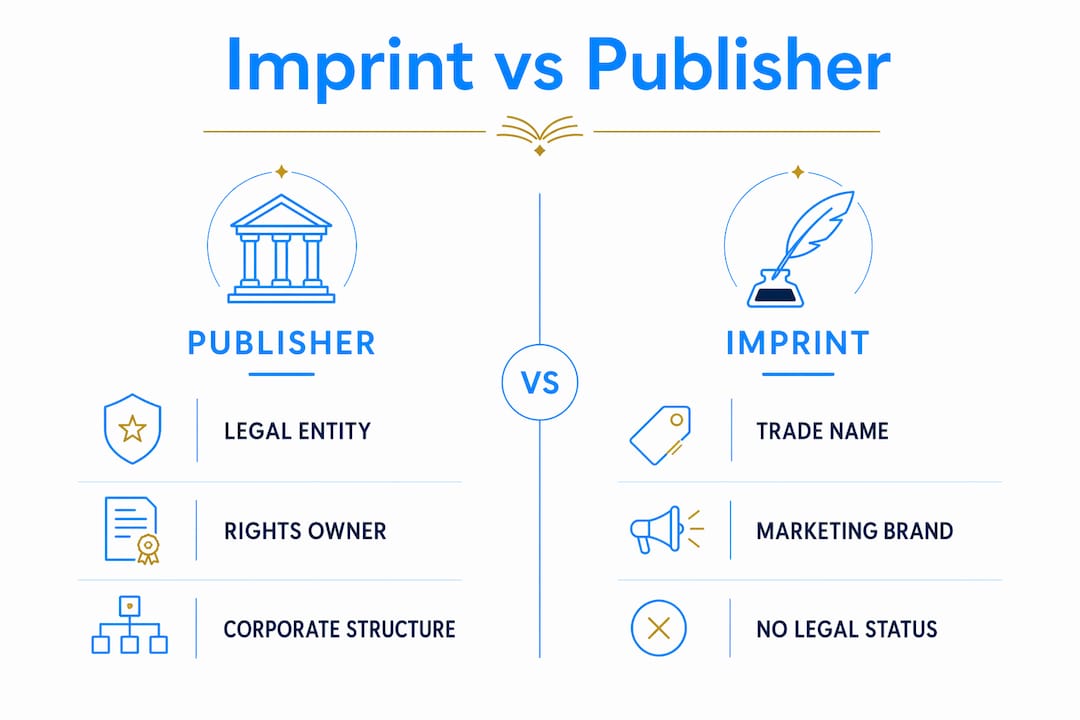
A publishing imprint is a trade name or brand used for a line of books. It is not a separate legal entity. The parent publishing company owns the rights, signs the contracts, manages distribution, and handles all core business operations. The imprint is the face readers, booksellers, and librarians see.
Think of it this way. A parent company is the legal structure. The imprint is the storefront sign. When you buy a thriller published under Mulholland Books, you are buying a product of Little, Brown and Company, which is itself owned by Hachette Book Group. The imprint name is what appears in retail metadata, on the spine, and on the copyright page as the publisher’s label, even though a much larger corporate machine operates behind it.

Here is a direct comparison to make the distinction concrete:
| Feature | Publisher (parent company) | Imprint |
|---|---|---|
| Legal status | Registered legal entity | Trade name, not a separate legal entity |
| Core function | Owns rights, manages contracts and distribution | Editorial brand and marketing identity |
| Visibility to readers | Rarely seen on book covers | Appears on cover, spine, and copyright page |
| Decision-making | Corporate strategy and finance | Editorial taste, genre focus, cover aesthetics |
| Example | Penguin Random House | Anchor Books, Knopf, Vintage |
The distinction matters for authors because it affects who you are actually pitching to. When a literary agent submits your manuscript to an editor at Riverhead Books, they are targeting that imprint’s editorial taste, not Penguin Random House as a whole.
Why do large publishers operate multiple imprints?
A single publishing company may operate dozens of imprints, each using a different name to market books to distinct demographic segments. This is not redundancy. It is precision targeting at scale.
Imprints allow publishers to specialize without fragmenting their business infrastructure. Penguin Random House can publish literary fiction under Riverhead, mass-market romance under Berkley, children’s books under Dial Books, and audiobooks under separate audio-focused lines, all while sharing the same printing contracts, distribution networks, and legal departments. The editorial teams, however, operate with significant independence.
Imprints exist to help publishers target specific audiences, genres, and formats, and they are often led by editorial directors with a particular taste or a defined mandate. That leadership shapes everything from which manuscripts get acquired to how covers are designed and how books are positioned at retail. An imprint focused on narrative nonfiction will develop relationships with different reviewers, media outlets, and booksellers than one focused on young adult fantasy.
The benefits of this structure extend beyond the publisher:
- For agents: Imprints serve as a roadmap for where to pitch manuscripts based on editorial focus, saving time and improving match quality.
- For readers: A familiar imprint signals a certain type of reading experience, building loyalty over time.
- For booksellers: Imprint identity helps with shelving decisions, catalog ordering, and staff recommendations.
- For authors: Being acquired by the right imprint means working with a team that already knows how to sell your kind of book.
Pro Tip: When researching traditional publishers, study the imprints rather than the parent companies. Look at the last 20 books an imprint published, not just the house’s general catalog. That list tells you far more about editorial fit.
What benefits do publishing imprints offer authors and readers?
People working at imprints develop deep expertise in the kind of books their imprint is known for and know exactly how to market them. That specialization is a genuine advantage for authors. A debut thriller writer placed with Minotaur Books lands in the hands of editors and publicists who have spent years building relationships with crime fiction reviewers, mystery bookstores, and thriller readers. That network does not exist at a generalist imprint.
Imprints also shape reader expectations in ways that drive purchasing decisions. When a reader sees the Tor Books logo on a science fiction novel, they already have a set of quality expectations before reading a single page. That trust is built over decades of consistent editorial choices. An imprint typically has its own editors, sales targets, and sometimes distinct cover aesthetics and marketing language within the larger publisher, which reinforces that reader recognition.
For authors, the alignment between your book and an imprint’s identity also affects long-term career positioning. A literary novelist published under FSG (Farrar, Straus and Giroux) carries a different market signal than one published under a mass-market paperback line, even if both books are excellent. That signal influences reviews, award consideration, and how future books are positioned.
“Authors benefit most when their work is aligned with an imprint’s specialized marketing and editorial team that is already familiar with the genre.” — Marketplace
The importance of publishing imprints, then, is not just structural. It is strategic. The right imprint match amplifies a book’s chances of reaching its intended audience with the right framing.
How can independent authors create their own publishing imprint?
Independent authors can and should create a publishing imprint to increase professionalism and market appeal. A publishing imprint is the name of your publishing company, displayed wherever you sell your book and recorded in metadata. When you self-publish under your own imprint rather than listing yourself as the publisher, your book looks indistinguishable from traditionally published titles in retail databases.
Here is how to set one up:
- Choose a name. Pick something that does not include your personal name and does not sound like a vanity press. Names like “Ridgeline Press” or “Cobalt House Books” signal a professional operation. Search the U.S. Copyright Office records and your state’s business registry to confirm the name is available.
- Register a DBA (Doing Business As). In most U.S. states, you register your imprint name as a fictitious business name or DBA through your county clerk’s office. This is inexpensive and gives your imprint legal standing for business purposes.
- Purchase ISBNs under your imprint name. Buy ISBNs through Bowker (the U.S. ISBN agency) and register them under your imprint name, not your personal name. This is the step most indie authors skip, and it is the one that matters most for how your book appears in retail and library databases.
- Update your copyright page and metadata. List your imprint as the publisher on the copyright page and in all distribution platform metadata, including Amazon KDP, IngramSpark, and Draft2Digital. This is what booksellers and readers actually see.
- Build a presence for your imprint. A simple author website that references your imprint reinforces the brand and gives media contacts a professional landing point.
Pro Tip: Do not use your imprint name as your author name or book title. Keep the three identities separate: you as the author, your book as the product, and your imprint as the publisher. That separation is what makes your publishing operation look credible to retailers, librarians, and readers.
Understanding indie publishing costs before you set up your imprint helps you budget realistically for ISBNs, distribution fees, and any professional services you bring in. The total investment is far lower than most authors expect, and the professional return is significant.
Key takeaways
A publishing imprint is a trade name used to brand a line of books, and choosing or creating the right one directly shapes how your book is positioned, marketed, and perceived by readers and the industry.
| Point | Details |
|---|---|
| Imprint vs. publisher | An imprint is a brand name, not a legal entity. The parent company handles rights and distribution. |
| Strategic purpose | Large publishers use multiple imprints to target specific genres, formats, and reader demographics. |
| Author advantage | Imprint specialization means dedicated editorial and marketing expertise matched to your book’s genre. |
| Indie imprint creation | Register a DBA, buy ISBNs under your imprint name, and update all metadata for a professional appearance. |
| Reader trust | Imprint reputation builds reader expectations and loyalty that benefit every book published under that brand. |
Why imprints matter more than most authors realize
I have worked with authors at every stage of the publishing process, and the imprint question comes up far later than it should. Most writers spend months perfecting their manuscript and almost no time thinking about the publishing brand that will carry it into the world. That is a mistake I have watched cost authors real visibility.
Here is what I have observed: when a book is published under a well-matched imprint, whether traditional or self-created, it moves through the industry with less friction. Booksellers know where to shelve it. Reviewers know which readers to recommend it to. Librarians know which collections it belongs in. The imprint does not just label the book. It communicates context before anyone reads a word.
For indie authors specifically, creating your own imprint is one of the highest-leverage moves you can make. It costs almost nothing and changes everything about how your book is received. I have seen self-published authors with strong imprints get stocked in independent bookstores and reviewed in genre publications, outcomes that rarely happen when the publisher field just lists the author’s name.
The one caution I would offer: do not create an imprint and then ignore it. Treat it like a real brand. Keep the cover design consistent across your titles. Use the same imprint name on your website, your press materials, and your social profiles. The different publishing paths available today all benefit from this kind of intentional branding, whether you go traditional, hybrid, or fully independent.
The authors who treat their imprint as a real publishing identity, not just a metadata field, are the ones who build lasting credibility in the market.
— James
How Altopublishinggroup supports your publishing imprint

Setting up a publishing imprint is one step. Building the full professional presence around it is another. Altopublishinggroup works with independent and self-published authors to create the complete package: publishing and editing services, author branding, website design, press release support, and marketing materials that make your imprint look credible from day one. You keep full ownership of your work and all your royalties. Altopublishinggroup handles the professional infrastructure that makes readers, booksellers, and media take your book seriously. If you are ready to publish under your own imprint with the polish of a traditional house, explore what we offer and see how we can support your next book.
FAQ
What is a publishing imprint in simple terms?
A publishing imprint is the brand name that appears as the publisher on a book’s cover and copyright page. It is a trade name used to identify a specific line of books, not a separate legal company.
Does an imprint own the rights to a book?
No. The parent publishing company owns the rights and handles all legal and business operations. The imprint is a marketing and editorial identity, not a legal entity with independent ownership.
Can a self-published author create their own imprint?
Yes. Independent authors can register a business name (DBA), purchase ISBNs under that name through Bowker, and list the imprint as the publisher in all retail and distribution metadata to create a professional publishing identity.
How do I choose the right imprint name?
Choose a name that does not include your personal name, sounds like a real publishing house, and is not already in use. Check your state’s business registry and the Bowker Books in Print database before registering.
Why do publishers like Penguin Random House have so many imprints?
Large publishers use multiple imprints to target different genres, formats, and reader demographics with specialized editorial and marketing teams, while sharing the same distribution and legal infrastructure across all titles.


