


A professional author website is a dedicated digital hub where you present your books, brand, and personality to build credibility, attract readers, and own your marketing platform outright. Unlike social media profiles, your website is the only piece of online real estate you truly own. Algorithms cannot bury it. Platforms cannot suspend it. For authors at any career stage, this distinction matters more than most realize. Jerry B. Jenkins describes an author website as the foundational element of an author platform, critical for building direct reader relationships that no third-party platform can take away.
What is a professional author website and why does it matter?
A professional author website, sometimes called an author platform site or author hub, is a purpose-built website that serves three core functions: showcasing your books, establishing your credibility, and connecting you directly with readers and industry professionals. It is not a blog, a social media page, or an Amazon author profile. Those tools support your platform. Your website is the platform.
The distinction carries real weight. Social media platforms change algorithms, restrict reach, and occasionally suspend accounts without warning. Your website and email list sit outside that risk entirely. Agents and publishers also check author websites before responding to queries. A polished, professional site signals that you take your career seriously. A missing or poorly built one signals the opposite.

The term “author platform” is the recognized industry standard for the full ecosystem of your online presence. Your professional author site is the center of that ecosystem. Everything else, including Instagram, TikTok, and podcast appearances, feeds traffic back to it.
What core elements does every author website need?
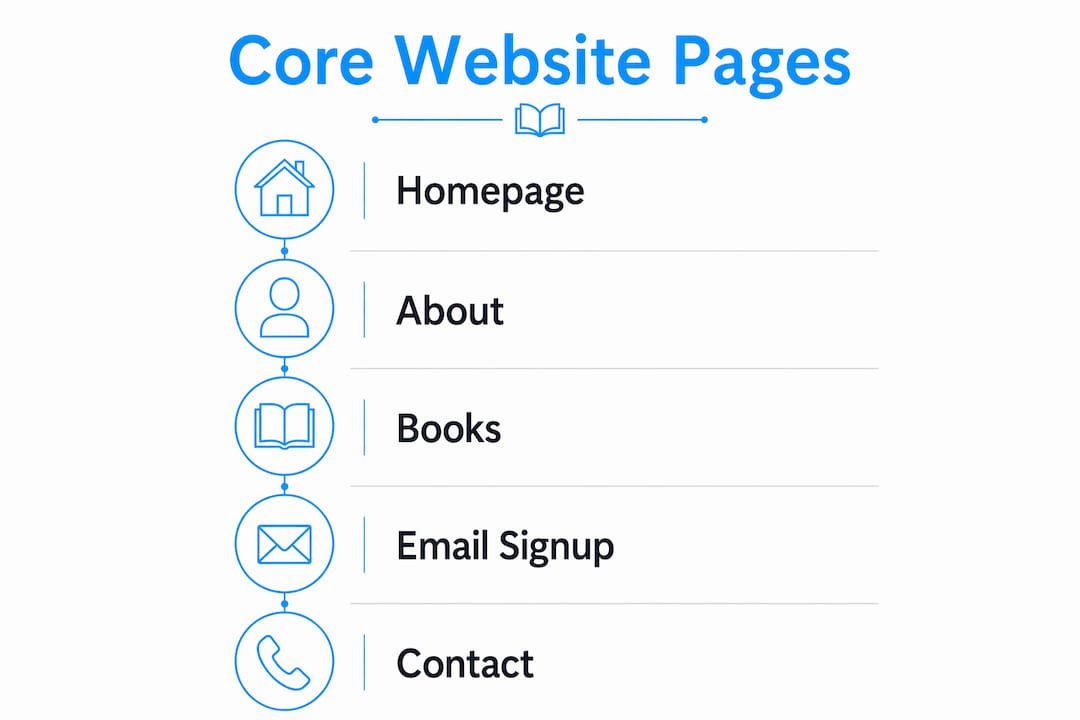
Five minimum core pages form the foundation of any effective author website: a homepage, an About page, a Books page, a Contact page, and an email signup landing page. Each one serves a specific purpose, and skipping any of them creates a gap that readers and industry professionals will notice.
Your homepage must answer three questions in under five seconds: who you are, what you write, and where someone can buy your books. Immediate visitor clarity is not a design preference. It is a conversion requirement. Visitors who cannot orient themselves within seconds leave without acting.
The About page is where you connect personally while staying professional. Readers want to know the person behind the books. Agents want to see your credentials and publishing history. Write it in first person, keep it focused, and include a professional photo. The Books page needs cover images, back-cover blurbs, and direct purchase links. Amazon already offers speed and convenience. Your website adds the personal touch: signed copies, bonus content, and your story.
The email signup page is arguably the most valuable page on your entire site. It is where casual visitors become committed readers. A Contact page rounds out the minimum set, giving media, agents, and readers a direct line to you.
Pro Tip: Add a media or press page once you have speaking engagements, podcast appearances, or book reviews to list. Agents and journalists look for this page specifically.
How should authors design their sites for professionalism and engagement?
Clean, simple design outperforms complex design every time. The biggest mistake authors make is overcomplicating their websites. Too many fonts, too many colors, too many navigation options, and too much competing content all dilute the one action you want visitors to take.
Over 60% of all website traffic now comes from mobile devices. That means your site must look and function correctly on a phone screen before it looks good on a desktop. Mobile responsiveness is not optional. It is the baseline. A site that breaks on mobile loses the majority of its visitors before they read a single word.
Fast loading times matter just as much. Pages that take more than three seconds to load see dramatically higher bounce rates. Use compressed images, minimal plugins, and a reliable hosting provider to keep load times short. Navigation should be obvious. Visitors should never have to search for your books page or your email signup.
Visual hierarchy guides the eye toward your most important calls to action. Your email signup and book purchase links should appear above the fold on your homepage, then repeat at natural scroll points throughout the page. This is not aggressive marketing. It is good design.
Pro Tip: Choose a website template built specifically for authors or creatives. Generic business templates require significant customization to feel right for a book-focused site. Platforms like Squarespace and WordPress both offer author-specific themes that save hours of setup.
SEO basics also belong in your design plan from day one. Use your author name and genre in your page titles, meta descriptions, and image alt text. Write a short bio that includes the types of books you write. These small steps make your site findable without requiring technical expertise.
How do authors build and grow their audience through their website?
Your email list is the most valuable marketing asset you will ever build as an author. Social media followers can disappear overnight. Email subscribers are yours. The question is not whether to build a list. It is how to build it fast enough to matter.
A meaningful lead magnet grows your email list three to five times faster than a generic “subscribe for updates” offer. The best lead magnets for fiction authors include a free prequel novella, deleted chapters, or a behind-the-scenes PDF about your writing process. For nonfiction authors, a checklist, mini-guide, or exclusive chapter works well. The lead magnet must feel genuinely valuable, not like a consolation prize.
Strategic placement of your signup forms determines how many visitors actually convert. Follow this sequence:
- Place a signup form in your hero banner at the top of your homepage, paired with your lead magnet offer.
- Add a mid-content signup form on your About page, where readers are already engaged with your story.
- Include a footer signup on every page so no visitor reaches the bottom without seeing the offer.
- Use a timed pop-up that appears after 30 to 45 seconds, giving visitors time to engage before the prompt appears.
High-converting author sites use all four of these placements. Each one captures a different type of visitor at a different moment of intent.
Clear messaging is the other half of the conversion equation. Your homepage copy must communicate who you are and what readers get in under five seconds. Vague taglines like “Stories that inspire” tell readers nothing. Specific ones like “Dark fantasy thrillers for readers who loved Joe Abercrombie” tell readers exactly whether they belong on your site.
Pro Tip: Test your homepage on someone who has never seen it. Ask them to describe what you write and where to buy your books after five seconds. If they cannot, your messaging needs work.
Your website also builds credibility with publishers and literary agents. A site that looks professional, loads quickly, and clearly presents your work signals that you are a serious author who understands the business side of publishing.
What platforms and tools help authors create their sites?
Choosing the right platform is the first practical decision you make when building your author site. Four platforms dominate the space for good reason.
| Platform | Best for | Cost range | Coding required |
|---|---|---|---|
| WordPress | Authors who want full control and SEO power | $5 to $25/month | Minimal with themes |
| Squarespace | Authors who want polished design with minimal setup | $16 to $23/month | None |
| Wix | Authors who want drag-and-drop simplicity | $17 to $35/month | None |
| Carrd | Authors who want a simple one-page site to start | Free to $19/year | None |
WordPress powers 40% of all websites globally, which reflects its flexibility and affordability. It offers thousands of themes, strong SEO tools, and integrations with every major email marketing platform, including Mailchimp, ConvertKit, and MailerLite. Squarespace trades some flexibility for a significantly faster setup time and consistently beautiful templates.
You can build a functional author website in one to two weekends using templates on Squarespace or WordPress, even with no coding skills. Custom professional design costs between $3,000 and $10,000, but most authors do not need this at the start of their careers. Invest in a professional designer only after your author career generates consistent revenue, typically after your second or third book.
Your domain name should match your author name as closely as possible. If your name is taken, add “author” or “books” to the domain. For example, janesmith.com becomes janesmithauthor.com or janesmithbooks.com. Keep it simple and memorable.
Key integrations to set up from day one include:
- An email marketing platform (ConvertKit is widely used by authors for its automation features)
- A way to sell directly, such as Payhip or Shopify, if you plan to offer signed copies or digital downloads
- Google Analytics to track which pages drive the most engagement and where visitors drop off
Key takeaways
A professional author website is the only marketing asset you fully own, and building it correctly from the start saves significant time and money later.
| Point | Details |
|---|---|
| Own your platform | Your website and email list cannot be taken away by algorithm changes or platform shutdowns. |
| Five core pages | Every author site needs a homepage, About, Books, Contact, and email signup page at minimum. |
| Mobile-first design | Over 60% of traffic is mobile, so design for phones before desktops. |
| Lead magnets accelerate growth | A free novella or exclusive PDF grows your email list three to five times faster than a generic offer. |
| Start simple, then invest | Build on Squarespace or WordPress first. Hire a custom designer only after consistent book revenue. |
Why your author website is your most underrated career asset
I have reviewed hundreds of author websites over the years, and the pattern is consistent. The authors who struggle most are not the ones with the smallest audiences. They are the ones with the most cluttered websites. Three fonts, five navigation items, a blog they stopped updating in 2022, and a homepage that leads nowhere specific.
Elizabeth Spann Craig puts it well: your site should act as a warm, simple front door for readers, not a warehouse of everything you have ever done. That framing changed how I think about author sites entirely. A front door is welcoming, clear, and points you inside. A warehouse is overwhelming and makes you want to leave.
The authors I have seen build genuine audiences online share one habit: they treat their website as a living tool, not a static brochure. They update their Books page when a new title launches. They refresh their lead magnet when signup rates drop. They check their analytics quarterly to see what is working.
The other thing I would push back on is the idea that you need a perfect site before you launch. A simple, clear site published today beats a complex, beautiful site that launches in six months. Start with Carrd or a basic Squarespace template. Get your email list started. Add pages as your career grows. The authors who wait for perfect never publish. The ones who start simple and iterate consistently are the ones who build real platforms.
Your website is not a vanity project. It is the professional foundation that every other part of your marketing career is built on. Treat it that way.
— James
How Altopublishinggroup can help you build your author website
Building a professional author site from scratch takes time, and getting the design, copy, and SEO right on the first attempt is harder than most authors expect. Altopublishinggroup specializes in author website design and SEO built specifically for independent and self-published authors who want to look credible and market-ready without giving up creative control.
Beyond website creation, Altopublishinggroup offers social media marketing for authors, editing coordination, book marketing assets, and press release services, so your website sits inside a complete author platform rather than standing alone. If you are ready to build a site that works as hard as your writing does, Altopublishinggroup has the tools and expertise to get you there.
FAQ
What is a professional author website?
A professional author website is a dedicated online hub where authors present their books, bio, and brand to build credibility with readers, agents, and publishers. It serves as the center of an author’s marketing platform and the only digital asset they fully own.
How many pages does an author website need?
Every author website needs at minimum five pages: a homepage, About page, Books page, Contact page, and an email signup landing page. Additional pages like a media kit or blog can be added as your career grows.
What is the best platform for building an author website?
WordPress and Squarespace are the most widely used platforms for author websites. WordPress offers the most flexibility and SEO control, while Squarespace delivers polished design with minimal technical setup required.
How long does it take to build an author website?
Most authors can build a functional site using templates on Squarespace or WordPress in one to two weekends. Custom professional design takes four to eight weeks and typically costs between $3,000 and $10,000.
Do authors really need a website if they have social media?
Social media platforms can change algorithms or suspend accounts without warning, making them unreliable as a primary marketing channel. Your website and email list are assets you control completely, which makes them the more durable long-term investment.


