


Full-service publishing is a complete, managed process in which a publisher or publishing partner handles every stage of producing and distributing a book, from raw manuscript to market-ready product. Unlike hiring individual freelancers or going fully independent, this model gives authors a single coordinated system covering editing, design, production, distribution, and marketing. Understanding what does full-service publishing include helps you evaluate whether the investment matches your goals, your budget, and your expectations for professional quality.
What does full-service publishing include?
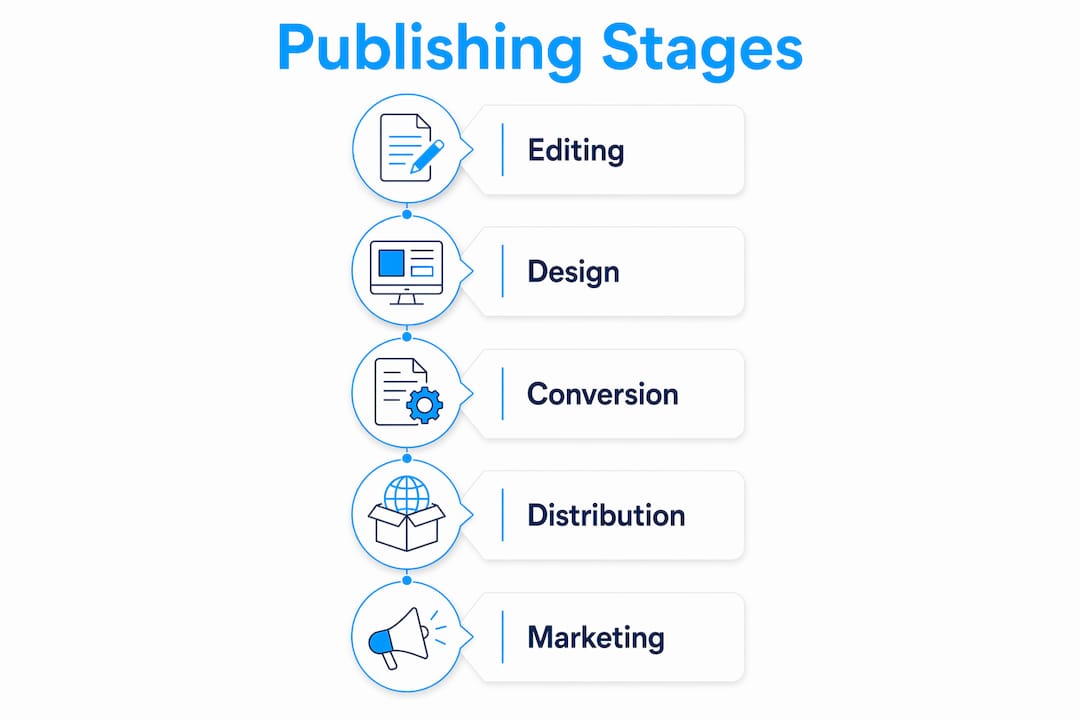
Full-service publishing, also called end-to-end publishing, covers the entire production chain under one managed workflow. The industry term “end-to-end publishing services” is the recognized standard. The phrase “full-service publishing” is widely used by authors and service providers, but both terms describe the same model. Here is what a complete package typically contains.
Project management and coordination sit at the foundation of every reputable package. A dedicated project manager tracks manuscript progress, coordinates vendor tasks, and keeps your publishing timeline on schedule. This single point of contact removes the confusion of managing five or six separate contractors at once.
Editorial services form the core of any credible publishing package and typically run in three stages:
- Developmental editing addresses structure, pacing, and argument clarity at the manuscript level.
- Copyediting corrects grammar, syntax, consistency, and style.
- Proofreading catches final errors before the file goes to production.
Cover design and interior formatting follow editorial approval. Professional cover design is not cosmetic. A well-designed cover directly affects whether a reader clicks on your book in an online store. Interior typesetting creates a readable layout, and for technical or academic titles, this includes handling complex elements like mathematical formulas and chemical structures.
Digital conversion produces the final deliverable files. A full-service provider generates PDF, EPUB, and HTML versions of your book, each formatted to meet the requirements of specific retail and library platforms. XML-first workflows and metadata creation, including ONIX feeds, make your book discoverable across distribution channels.

ISBN registration and legal deposit are administrative steps most first-time authors overlook. A full-service provider handles both, registering your title in national and international databases so retailers and libraries can stock it.
Distribution setup connects your finished book to physical and digital retailers, including Amazon, Barnes and Noble, Ingram, and library wholesalers. Some packages also include audiobook production and distribution.
Marketing and promotional support varies widely by provider. At minimum, expect press release drafting, back-cover copy, and metadata optimization. Premium packages may include author website creation, social media assets, and media outreach.
How does full-service publishing compare to other paths?
Authors in 2026 have three realistic publishing paths: traditional publishing, DIY self-publishing, and full-service or hybrid publishing. Each has a different cost structure, timeline, and level of creative control.
| Publishing path | Creative control | Upfront cost | Time to market | Professional support |
|---|---|---|---|---|
| Traditional publishing | Low to moderate | None (advance paid to author) | 18 to 36 months | Full, but publisher owns rights |
| DIY self-publishing | Full | $2,940 to $5,660 for professional production | 3 to 12 months | None unless hired separately |
| Full-service publishing | Full | Varies by package | 3 to 9 months | Full, author retains rights |
DIY self-publishing costs for a fully professional book range from $2,940 to $5,660 when you hire editing, cover design, formatting, and distribution setup separately. That figure reflects the real market rate for quality work in 2026. Full-service packages bundle those same services, often at a comparable or lower total cost, while removing the coordination burden from the author.
Traditional publishing offers no upfront cost to the author, but the publisher owns the rights and controls every production decision. Full-service publishing preserves your ownership while delivering the same professional output.
Pro Tip: Before signing any full-service publishing contract, request an itemized list of every deliverable. Vague language like “marketing support” can mean a single social media post or a three-month campaign. Specificity protects your investment.
AI-native platforms now offer flat-rate subscriptions that bundle writing tools, cover templates, EPUB export, and audiobook narration for as little as $9.99 per month. These tools reduce production costs substantially, but they do not replace human editorial judgment or strategic marketing. Full-service providers that integrate AI tools for efficiency while retaining human oversight represent the strongest value in the current market.
What are the digital workflows and quality checks involved?
Modern full-service publishing runs on structured digital workflows that go well beyond editing and design. Production in full-service publishing extends to technical setup including XML workflows, data structuring, and rigorous quality assurance to minimize layout and formatting errors. This technical layer is what separates a polished, widely distributed book from one that renders incorrectly on a Kindle or fails metadata validation on IngramSpark.
The standard production workflow moves through these phases:
- Manuscript intake and style guide setup
- Copyediting and proofreading passes
- Typesetting and pagination
- XML structuring and metadata creation
- Artwork processing for resolution and labeling accuracy
- Accessibility compliance checks (alt text, reading order)
- Final file generation in PDF, EPUB, and HTML
- Platform-specific validation before distribution submission
High-quality typesetting includes artwork enhancement to produce crisp, accurate reproduction on every device, from a high-resolution desktop monitor to a low-contrast e-ink reader. This matters more than most authors realize. A book that looks sharp in print but breaks on a tablet loses readers and reviews.
“End-to-end publishing services provide continuous support from manuscript development through digital delivery, encompassing editorial, typesetting, metadata creation, artwork processing, production management, and final delivery aligned with platform requirements.”
Quality assurance is not a single final check. Reputable full-service providers run validation at multiple stages, catching errors in layout, metadata, and file structure before they reach a retailer’s ingestion system. This reduces the risk of rejected uploads, delayed launches, and formatting complaints in reader reviews.
What should you look for when choosing a provider?
Choosing a full-service publishing provider is a business decision, not just a creative one. The wrong choice costs you time, money, and market momentum. Evaluate every candidate against these criteria.
- Package transparency. Every deliverable should be listed by name. If a provider cannot tell you exactly how many editing passes are included or which distribution channels are covered, that is a red flag.
- Editorial team quality. Ask for sample edits or editor bios. A professional editing team with genre experience produces measurably better results than a generalist proofreader.
- Design portfolio. Review actual covers and interior layouts the provider has produced. Strong design work is visible immediately.
- Distribution reach. Confirm which retailers and library platforms your book will reach. Amazon alone is not sufficient for serious authors.
- Marketing deliverables. Clarify whether press release services, social media assets, or media outreach are included or available as add-ons.
- Client testimonials and track record. Published authors who have used the service are your best source of honest feedback. Look for reviews that mention specific outcomes, not just general satisfaction.
- Rights and royalties. Confirm in writing that you retain full ownership of your manuscript, cover art, and all derivative rights. A full-service provider should never take a royalty share.
Pro Tip: Request a sample project timeline before you commit. A provider who cannot outline a realistic production schedule from manuscript submission to distribution launch is likely to miss deadlines once your project starts.
Pricing transparency is equally critical. The 2026 cost breakdown for professional publishing services varies significantly by provider type, package scope, and whether AI-assisted tools are used. Comparing itemized quotes across two or three providers gives you a realistic baseline before you sign.
Key takeaways
Full-service publishing is the most efficient path for authors who want professional quality and full rights retention without managing a dozen separate vendors.
| Point | Details |
|---|---|
| Core services covered | Full-service packages include editing, cover design, typesetting, digital conversion, ISBN registration, distribution, and marketing. |
| Single point of contact | A dedicated project manager coordinates all vendors and keeps your production timeline on schedule. |
| Rights and royalties | Reputable full-service providers never take a royalty share. Authors retain full ownership of their work. |
| Digital workflows matter | XML structuring, metadata creation, and multi-platform validation prevent costly errors at distribution. |
| Evaluate before signing | Request itemized deliverables, editor bios, a design portfolio, and a written production timeline before committing. |
Why the single point of contact changes everything
I have worked with authors who hired five separate freelancers for their first book. A developmental editor, a copyeditor, a cover designer, a formatter, and a distributor. Every handoff created a new delay. The formatter received a file the editor had not finalized. The cover designer delivered artwork in the wrong dimensions for print. Nobody owned the timeline, so nobody protected it.
The most underrated benefit of full-service publishing is not the editing or the design. It is the project manager who sits in the middle of all of it. That person catches the problems before they compound.
I also think authors underestimate how much professional editing costs when done correctly. The industry data on DIY publishing costs reflects real market rates, and editing is the single largest line item. Authors who cut that budget first are making a mistake they will feel in their reviews. A full-service package that bundles editing at a negotiated rate often delivers better value than sourcing it independently.
The misconception I hear most often is that full-service publishing means giving up control. It does not. The traditional publishing model takes your rights. A legitimate full-service provider takes your production headaches and hands you a finished, market-ready book that you own completely. That distinction matters enormously.
— James
How Altopublishinggroup supports your publishing journey
Altopublishinggroup was built specifically for independent authors who want professional results without surrendering creative control or royalties. Every package includes editing coordination, cover design, interior formatting, and distribution setup, backed by a team that treats your book as a serious publishing project.

Beyond production, Altopublishinggroup supports your visibility with author website design, press release writing, social media marketing, and author branding assets. If you are ready to see exactly what professional publishing looks like for your project, explore the full publishing and editing services at Altopublishinggroup and take the first step toward a market-ready book you own completely.
FAQ
What does full-service publishing include at minimum?
At minimum, full-service publishing includes developmental editing, copyediting, proofreading, cover design, interior typesetting, digital file conversion to PDF and EPUB, ISBN registration, and distribution setup to major retail platforms.
How much does full-service publishing cost in 2026?
Professional DIY publishing costs range from $2,940 to $5,660 when services are sourced separately. Full-service packages bundle these components and often deliver comparable or better value by eliminating coordination costs and reducing the risk of errors between vendors.
Do I keep my rights with a full-service publisher?
Yes, with a legitimate full-service or hybrid publisher you retain full ownership of your manuscript, cover art, and all derivative rights. Always confirm this in writing before signing any agreement.
How is full-service publishing different from traditional publishing?
Traditional publishers fund production but take ownership of your rights and control every creative decision. Full-service publishing gives you the same professional production quality while you retain full rights and royalties.
What digital formats does full-service publishing produce?
A complete full-service workflow generates PDF, EPUB, and HTML files, each validated against the technical requirements of specific retail and library platforms including Amazon Kindle Direct Publishing, IngramSpark, and library wholesalers.


