


Book publishing service costs are defined as the combined expenses of editing, cover design, formatting, distribution, and marketing required to bring a manuscript to market. Most serious self-published authors should budget between $2,500 and $5,660 for professional production, though platform fees and commission structures can shift your net earnings dramatically. When you compare book publishing service costs across platforms like Amazon KDP, IngramSpark, Draft2Digital, and Books.by, the differences go far beyond sticker price. The real number that matters is what lands in your pocket after every fee, commission, and print cost is subtracted.
What are the main cost components in book publishing services?
Every publishing budget breaks down into a handful of core categories. Understanding each one lets you decide where to spend and where to save.
Editing is the largest single expense for most authors. Developmental editing, which restructures your story or argument at the big-picture level, costs $2,500 to $12,000. Copyediting runs lower, typically $1,000 to $4,000, and proofreading sits at $500 to $1,500. Skipping professional editing is the fastest way to damage your reputation as an author before your book even sells a single copy.

Cover design is your book’s first sales tool. Pre-made covers from marketplaces like The Book Cover Designer or Canva Pro cost $50 to $300. Custom covers from a professional designer run $500 to $2,500. Readers absolutely judge books by their covers, and a cheap cover signals a cheap book regardless of the content inside.
Interior formatting costs $200 to $800 depending on complexity. A straightforward novel with no images formats quickly. A nonfiction book with charts, tables, and callout boxes takes significantly more work. Tools like Vellum and Atticus let tech-savvy authors handle formatting themselves for a one-time software cost of $100 to $250.
ISBNs cost $125 for a single number through Bowker in the United States, or $295 for a block of ten. Amazon KDP offers free ISBNs, but those ISBNs are locked to KDP and list Amazon as the publisher of record. Owning your own ISBN through Bowker keeps you listed as the publisher across all retail channels.
Marketing expenses vary enormously. A basic author website through platforms like Squarespace or WordPress costs $150 to $500 per year. Social media advertising on Facebook or Amazon Ads can run $300 to $3,000 for a launch campaign. Authors who skip marketing entirely rarely see meaningful sales regardless of how good the book is.
- Budget tier ($500 to $2,000): DIY formatting, pre-made cover, basic proofreading only
- Mid-range tier ($3,000 to $7,000): professional editing, custom cover, formatted interior, ISBN purchase
- Full-service packages ($10,000 to $20,000+): full editorial team, branding, marketing campaign, PR outreach
Pro Tip: Treat your editing and cover design budget as non-negotiable. These two line items protect your professional reputation. Cut costs on formatting or website setup instead, where DIY tools can genuinely match professional output.
How do major self-publishing platforms compare on fees and printing costs?
Platform fee structures look simple on the surface but get complicated fast once you factor in commissions, print costs, and distribution tiers. Here is how the four major platforms stack up.
| Platform | Setup Fee | Commission | Print Cost (250-page B&W) | Distribution |
|---|---|---|---|---|
| Amazon KDP | $0 | 30–40% of list price | ~$3.65 | Amazon + expanded (40% royalty) |
| IngramSpark | $0 (waived) | 1.875% market access fee | ~$4.45 | 40,000+ retailers and libraries |
| Draft2Digital | $0 | 10% of net revenue | N/A (ebook focus) | Multi-retailer ebook distribution |
| Books.by | $99/year | 0% | $5.26 | Print on demand |
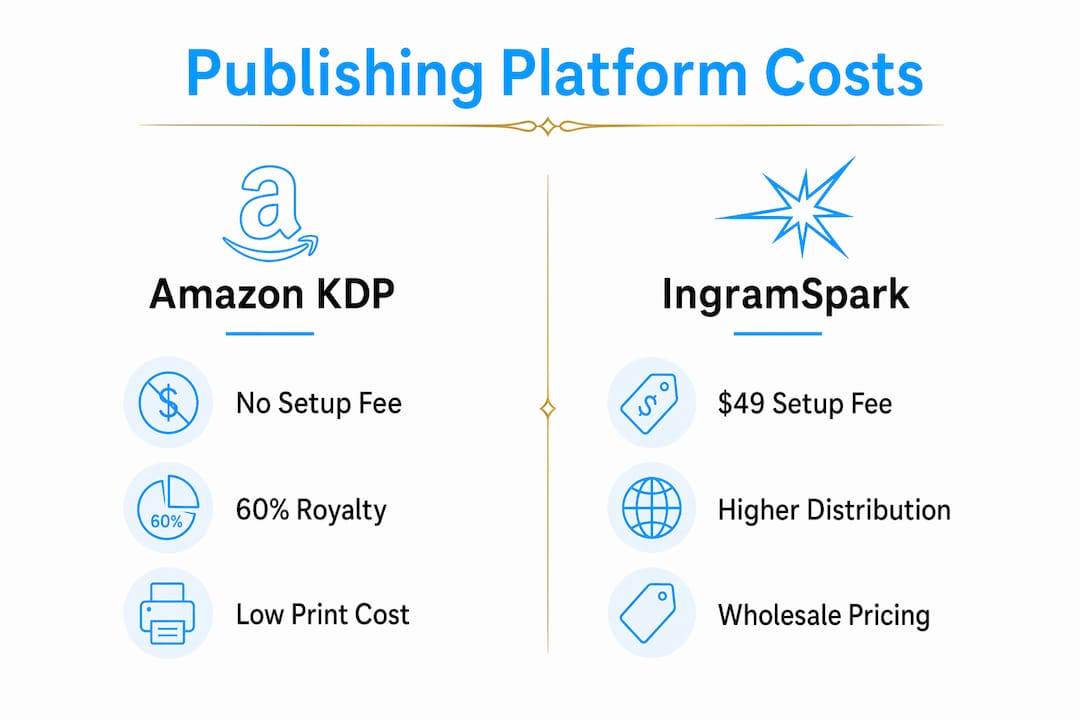
Amazon KDP is the default starting point for most self-published authors because the barrier to entry is zero. KDP Print royalties equal 60% of list price minus printing cost for Amazon.com sales. On a $14.99 paperback with a $3.65 print cost, you earn approximately $5.34 per copy. That number drops to 40% when you activate expanded distribution, meaning you earn roughly $2.35 per copy sold through non-Amazon retailers. That gap is significant over thousands of sales.
IngramSpark connects your book to over 40,000 retailers, libraries, and wholesalers worldwide, which KDP’s expanded distribution cannot match in depth. The royalty formula subtracts printing costs and the wholesale discount from your list price, then applies a 1.875% market access fee. On a $16.99 paperback with a $4.00 print cost and 40% wholesale discount, your net royalty is approximately $5.87 per copy. IngramSpark’s setup fee has been waived for most authors in 2026, though revision fees of $25 per file still apply after initial upload.
Draft2Digital shines for ebook distribution. It aggregates your ebook across Apple Books, Barnes and Noble, Kobo, and dozens of smaller retailers with no setup cost. The 10% commission on net revenue is straightforward and competitive. For print, Draft2Digital partners with IngramSpark, so you are effectively using Ingram’s infrastructure through a simplified interface.
Books.by operates on a subscription model at $99 per year with zero commission taken from sales. The trade-off is a higher print cost. A 250-page black and white paperback costs $5.26 to print versus $3.65 on KDP. For authors with high sales volume, the zero-commission model can outperform KDP’s lower print cost once you run the actual numbers.
Pro Tip: Many successful authors use KDP and IngramSpark simultaneously. Publish on KDP without activating expanded distribution, then use IngramSpark for all non-Amazon retail and library channels. This gives you the best royalty rate on Amazon and the widest distribution everywhere else.
What budget strategies can authors use to optimize publishing costs?
Comparing self-publishing costs is only useful if you have a framework for making decisions. The modular approach treats publishing as a series of independent investments rather than one bundled purchase.
- Identify your non-negotiables. Professional editing and cover design protect your book’s market credibility. These are the two areas where cutting costs creates the most visible damage to your author brand. Budget for these first before allocating anything else.
- DIY where tools are genuinely competitive. Formatting software like Vellum produces output that rivals professional formatters for standard novels. Author websites built on Squarespace or through a service like Altopublishinggroup’s author website design service can be launched quickly without a full web development budget.
- Calculate total platform cost, not unit cost. A platform with a $1.00 lower print cost but a 10% higher commission will cost you more money at scale. Platform commission structures have a greater long-term impact on profitability than minor printing cost differences.
- Stage your marketing spend. Spend nothing on paid advertising until your book has at least 10 verified reviews. Ads sent to a book with no social proof convert poorly and waste budget. Build your review base first through advance reader copies and your existing network.
- Avoid all-inclusive publishing packages from vanity presses. Companies that charge $5,000 to $15,000 for bundled services often deliver editing and design at below-market quality while retaining rights or taking royalty cuts. You get better results by hiring each service independently or working with a transparent publishing partner.
- Factor revision costs into your platform choice. IngramSpark charges $25 per file revision after initial upload. If you anticipate updating your book, those fees accumulate. KDP allows free revisions at any time, which matters if you plan to refresh your cover or correct errors post-launch.
The most common mistake authors make is spending heavily on printing proofs and platform experiments while underinvesting in editing. A beautifully printed book with weak writing will not sell. A well-edited book with a professional cover will find its audience even with modest marketing.
How to calculate and compare your net earnings from different publishing services
Royalty calculations look intimidating but follow a consistent logic across every platform. Here is a direct comparison using a standard 250-page paperback priced at $15.99.
| Platform | List Price | Print Cost | Commission/Fee | Net Royalty |
|---|---|---|---|---|
| Amazon KDP (Amazon.com) | $15.99 | $3.65 | 40% of list ($6.40) | ~$5.94 |
| Amazon KDP (expanded dist.) | $15.99 | $3.65 | 60% of list ($9.59) | ~$2.75 |
| IngramSpark (40% wholesale) | $15.99 | $4.45 | 40% wholesale + 1.875% fee | ~$5.12 |
| Books.by | $15.99 | $5.26 | $0 commission | ~$10.73 |
Books.by’s zero-commission model produces dramatically higher per-copy earnings despite the higher print cost. The catch is that Books.by does not offer the same retail distribution reach as KDP or IngramSpark. Authors who sell primarily through their own website or direct channels benefit most from the Books.by model.
Use the Books.by royalty calculator and KDP’s built-in pricing tool to run your specific numbers before committing to any platform. Both tools update in real time as you adjust page count, trim size, and list price.
Ordering proof copies before final publication costs $30 to $100 including shipping and is not optional. Digital previews miss binding issues, color shifts, and margin problems that only appear in a physical copy. Budget this into your production costs from day one.
Pro Tip: Run your royalty calculations at three price points: your target retail price, $2 below it, and $2 above it. You will often find that a slightly higher list price increases your net royalty per copy without meaningfully reducing sales volume, especially in nonfiction.
Key takeaways
The most effective way to compare book publishing service costs is to calculate net royalties across all fees combined rather than evaluating print costs or setup fees in isolation.
| Point | Details |
|---|---|
| Budget for editing first | Professional editing costs $2,500 to $12,000 and protects your reputation more than any other investment. |
| Platform fees compound | Commission structures affect long-term earnings more than unit print cost differences across KDP, IngramSpark, and Books.by. |
| Use platforms strategically | Combining KDP for Amazon sales and IngramSpark for retail distribution maximizes royalties and reach simultaneously. |
| Order proof copies | Physical proofs costing $30 to $100 catch formatting errors that digital previews consistently miss. |
| Avoid vanity press bundles | All-inclusive packages from vanity presses rarely deliver quality matching the cost of hiring services independently. |
What I’ve learned from watching authors spend money in the wrong order
Most authors I work with arrive having already made the same mistake. They spent $800 on a website, $400 on business cards, and $200 on a logo before they had a professionally edited manuscript. The book is the product. Everything else is packaging for a product that does not yet exist in sellable form.
The obsession with printing costs is another pattern I see constantly. An author will spend three hours comparing per-page print costs across platforms to save $0.40 per copy, then upload a cover designed in Canva by someone with no typography training. That cover will cost them thousands in lost sales. The $0.40 per copy savings is irrelevant.
What actually works is spending money in sequence. Edit first. Design second. Format third. Then choose your platform based on where your readers actually buy books, not based on which platform has the lowest print cost. If your readers are on Amazon, KDP is your primary platform. If you are targeting libraries and independent bookstores, IngramSpark earns its place in your budget.
The 2026 platform changes worth watching are IngramSpark’s print cost increases and Books.by’s growing author community. Books.by is still a smaller platform, but its zero-commission model is genuinely disruptive for authors who build direct sales channels. I would not bet my entire publishing strategy on it yet, but I would absolutely run the numbers for any author selling more than 500 copies per year through their own website.
One more thing: do not confuse affordable book publishing options with cheap ones. The goal is maximum value per dollar spent, not minimum spend. A $4,000 editing investment that produces a book you are proud to promote for five years is far more affordable than a $500 edit that produces something you quietly stop mentioning after six months.
— James
How Altopublishinggroup helps you publish smarter, not just cheaper
Altopublishinggroup works with authors who want professional results without handing over their royalties or creative control to a traditional publisher or vanity press.
The team at Altopublishinggroup coordinates editing, cover design, formatting, author branding, and book marketing assets under one roof so you are not managing five separate contractors while trying to finish your manuscript. Every package is built around your specific budget and publishing goals, not a one-size-fits-all price list. If you want to look credible, polished, and market-ready while keeping full ownership of your work, explore Altopublishinggroup’s publishing and editing services to find the right fit for your next book.
FAQ
How much does it cost to self-publish a book professionally?
Most authors should budget between $2,500 and $5,660 for professional self-publishing, covering editing, cover design, and formatting. Full-service packages with marketing support can exceed $10,000.
What is the cheapest way to publish a book?
Amazon KDP offers $0 setup fees and free ISBNs, making it the lowest-cost entry point for self-publishing. DIY formatting and a pre-made cover can bring total production costs under $500, though quality trade-offs are significant.
How do KDP and IngramSpark royalties compare?
KDP pays 60% of list price minus print cost for Amazon sales, while IngramSpark pays list price minus print cost, wholesale discount, and a 1.875% market access fee. For a $16.99 paperback, IngramSpark typically yields around $5.87 per copy through retail channels.
Does Books.by offer better royalties than Amazon KDP?
Books.by charges a $99 annual fee with zero commission, which produces higher net royalties per copy than KDP for authors with consistent direct sales. The trade-off is a higher print cost of $5.26 versus KDP’s approximately $3.65 for a 250-page paperback.
Should I use one platform or multiple platforms to publish?
Using KDP for Amazon sales and IngramSpark for all other retail and library distribution is the most effective strategy for most authors. This combination maximizes your royalty rate on Amazon while giving your book access to over 40,000 non-Amazon retail channels through Ingram’s network.
Recommended
- Book Publishing & Editing Services | Professional Author Publishing | Alto Publishing Group
- Alto Publishing Group | A Publishing Company For Authors – Alto Publishing Group
- Press Release Services for Authors | Alto Publishing Group
- Author Website Design & SEO Services | Alto Publishing Group – Alto Publishing Group


